Anahita
In 1846, the artist William Morris Hunt received from his brother a translation of a Persian poem about the Zoroastrian goddess Anahita. In her original form, Anahita was the goddess of the waters, but the poem depicts a more recent and striking incarnation of Anahita as the goddess of the night. Hunt was captivated by the poem, and its subject occupied him for over three decades. He worked out his ideas in a series of studies, including sketches, a plaster relief, and even a painted tea tray, before receiving a commission in 1878 to paint two murals for the New York State Capitol building in Albany, one of which would be his ultimate portrayal of Anahita, called The Flight of Night.

William Morris Hunt, The Horses of Anahita, tinted plaster, ca. 1848-1850.
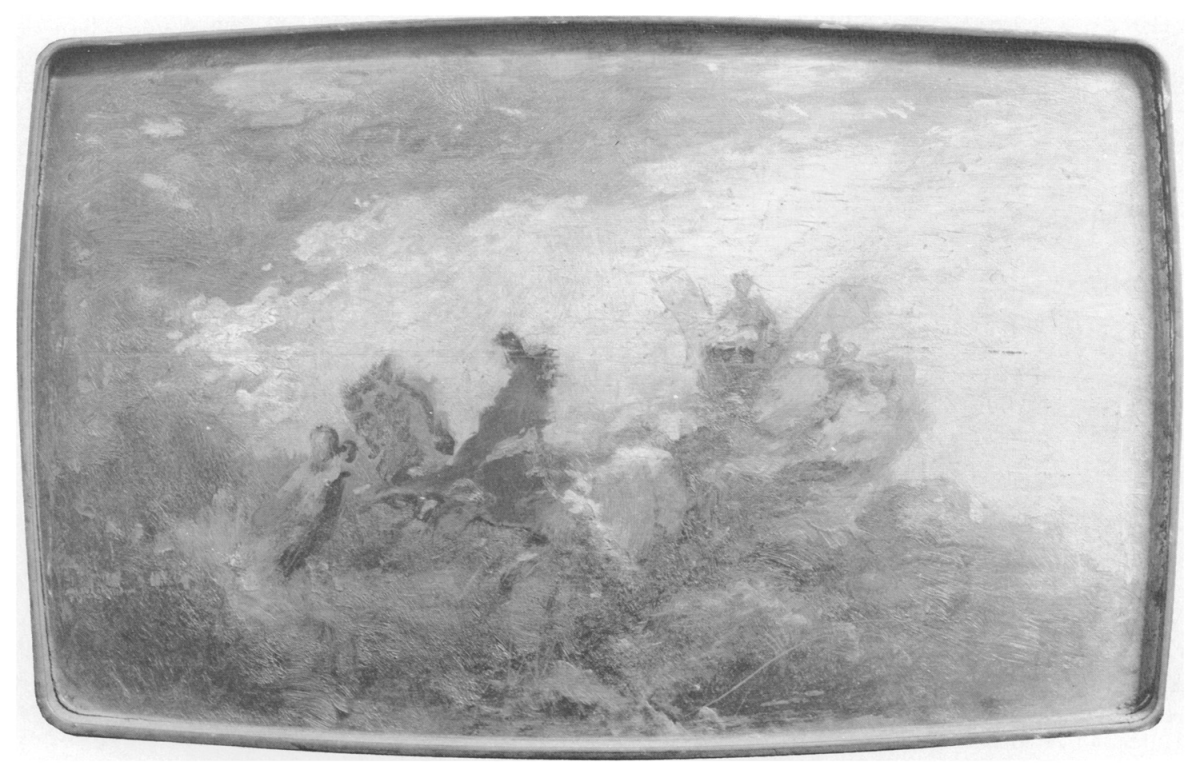
William Morris Hunt, Study for The Flight of Night, oil on Japanese tea tray, 1863.

William Morris Hunt, Anahita. The Flight of Night, oil and chalk on canvas, 1878.
Drawing inspiration from the translated poem, Hunt’s painting depicts Anahita, “enthroned upon her car of light.” On her left, the fearsome side of night, three frenzied “night mares” that pull her chariot, and a shrouded figure bearing a dark torch. On her right, the calmer side, in the form of a child and its mother: “And floating in her train Repose lies nestled on the breast of Sleep,” protected from the rising sun by a curtain of clouds.
Roshanne Etezady’s three-movement tone poem, Anahita, follows the same order in its perspective, beginning with the awesome and terrifying image of the goddess herself, followed by the ride of the night mares, and concluding with the peaceful portrait of Sleep and Repose, and the onset of the new day.
As for Hunt’s mural, it languishes mostly unseen—ten years after it was completed, the vaulted ceiling of the State Capitol was deemed unsafe and a lower ceiling needed to be built underneath it, almost completely obscuring The Flight of Night from view.
I programmed Etezady’s Anahita for my first concert with the UofT Wind Ensemble last year, and they delivered a dramatic and impressive performance, which can be viewed below.
Anahita
Enthroned upon her car of light, the moon
Is circling down the lofty heights of Heaven;
Her well-trained courses wedge the blindest depths
With fearful plunge, yet heed the steady hand
That guides their lonely way. So swift her course,
So bright her smile, she seems on silver wings.
O’er-reaching space, to glide the airy main;
Behind, far-flowing, spreads her deep blue veil,
Inwrought with stars that shimmer in its wave.
Before the car, an owl, gloom sighted, flaps
His weary way; with melancholy hoot
Dispelling spectral shades that flee
With bat-like rush, affrighted, back
Within the blackest nooks of caverned Night.
Still Hours of darkness wend around the car,
By raven tresses half concealed; but one,
With fairer locks, seems lingering back for Day.
Yet all with even measured footsteps mark
Her onward course. And floating in her train
Repose lies nestled on the breast of Sleep,
While soft Desires enclasp the waist of Dreams,
And light-winged Fancies flit around in troops.